

Appeal to Emotion — Critical Thinking Activity Book (Ages 10+)
Appeal to Emotion — Critical Thinking Activity Book (Ages 10+)
Ordering one pack? Shipping is calculated at checkout - or grab the digital version and print it tonight for less.
Couldn't load pickup availability
"Give me $5,000 and I'll double it with Bitcoin!" "No way." "Stay broke then, chicken!"
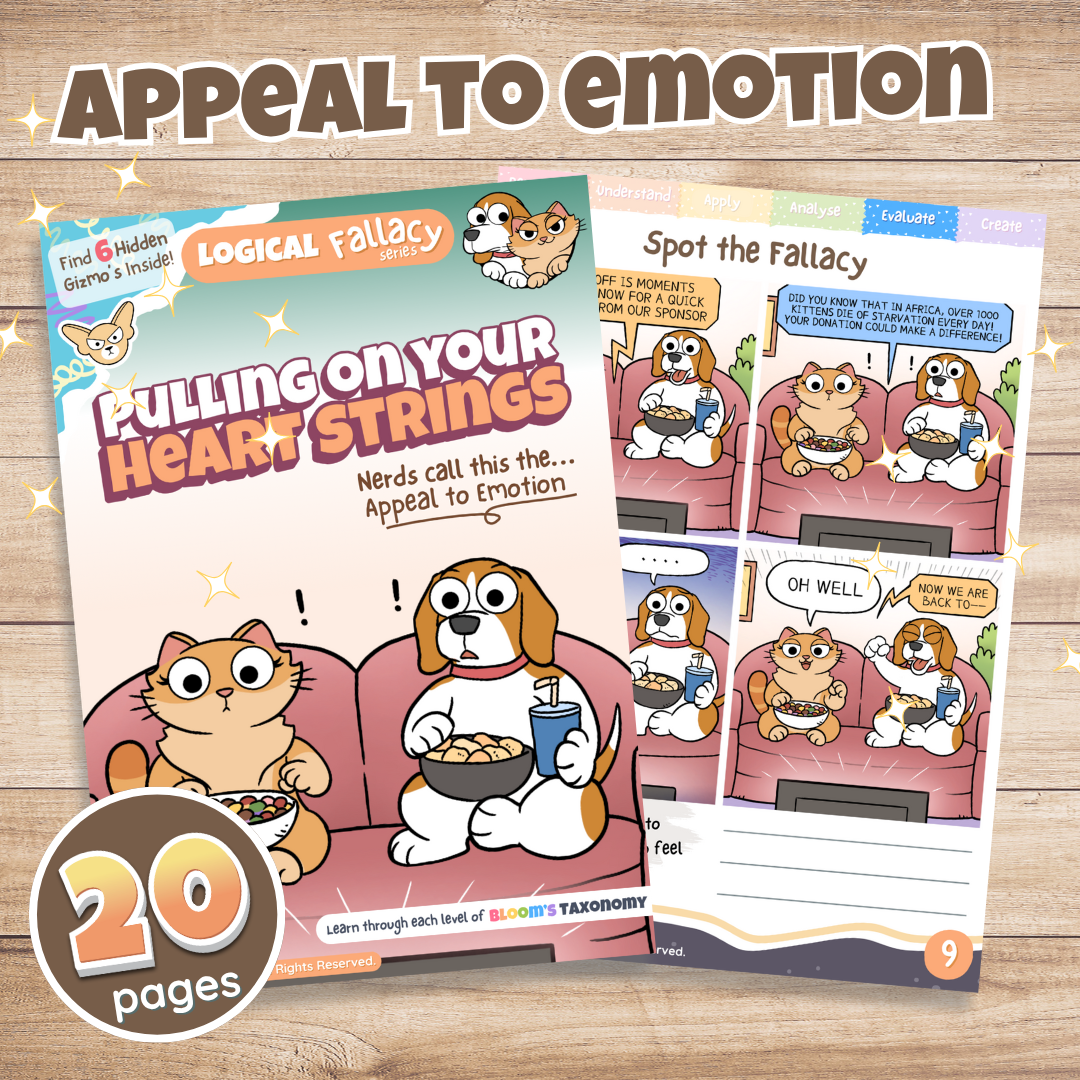
Big promises plus mockery for hesitating - a classic scam, because it skips your brain and goes straight for your feelings. That's the Appeal to Emotion. This 20-page pack teaches your kids to catch it, through one true story from history, an original comic, and hands-on activities.
⭐⭐⭐⭐⭐ Rated 5.0 on Etsy & TPT · Written by a real history teacher, drawn by hand, no AI.
The story inside
Most fallacy resources are a definition on a slide and a matching worksheet. This one teaches through storytelling - your kids watch the Appeal to Emotion cost 17,000 people their savings, laugh at it in a comic, then hunt for it in the wild. That sequence is why it sticks. Every word is researched from the original history books and written by hand - no AI, every fact checked.
This pack tells the story of Charles Ponzi, one of history's greatest con artists. In 1920 he was pulling in over $250,000 a day - about $4 million in today's money - on a scheme supposedly built on international reply coupons. But the real trick wasn't the coupons. It was emotions.
Ponzi spoke straight to people's hopes and fears: "Invest $100 and your kids can go to college." "Invest $1,000 and everyone will admire you." When people asked logical questions, he made them feel bad for doubting: "You don't trust me, after I made your friends rich?" When they wanted to pull out, he baited their greed: "Leave it six more months and you'll have two houses instead of one."
It wasn't until journalist William McMasters started asking questions - and the Boston Post published the exposé on 10 August 1920 - that the truth came out: Ponzi wasn't making money at all, just robbing Peter to pay Paul. Over 17,000 people lost millions, all because emotion did their thinking for them. The pack closes with a warning your kids will carry: "Whether it's fear, anger, hope or shame, look at the facts and don't be swayed by emotion alone."
What's in the pack
Illustrated historical story - Charles Ponzi, and how he stole millions by manipulating people's emotions.
Original comic - Duchess and Bruno hit the Appeal to Emotion in a scenario your kids will recognise instantly, with a "Break It Down" page that connects the joke to the concept.
Real-life examples - spot the fallacy in advertising, social media, news and politics.
Appeal to Emotion breakdown - clear definition, worked examples, and activities that build to mastery.
Interactive activities - Code Breaker puzzle, Match the Fallacy, The Great Word Hunt, and a Draw Your Own Comic page.
Hidden Gizmo hunt - a sneaky character hidden somewhere in the pack.
Answer sheet - for teachers, parents and group leaders. No prep required.
Bonus - the Expansion Pack (new) - a printable deep-dive question booklet that takes the Appeal to Emotion from "I get it" to "I can pull it apart," with questions that get your kids testing the logic, arguing both sides, and hunting the fallacy down in their own thinking. Included free with your digital download, in both A4 and US Letter.
You'll receive a professionally printed 20-page A4 booklet on quality stock, colour and black-and-white pages, answer sheet included, posted from the Gold Coast - plus the full digital file delivered instantly to print again any time. Prefer digital only? The complete pack downloads instantly, no shipping, no wait.
Who it's for & curriculum
Teachers wanting a critical thinking activity that actually engages middle schoolers, not just occupies them.
Homeschooling families who want structured, curriculum-aligned content that doesn't feel like a chore.
Parents who'd rather their kids interrogate a claim than swallow it.
Debate coaches and gifted programs looking for supplementary material with real depth.
Designed for ages 10+. Used successfully in middle school, high school, homeschool and family settings - and plenty of adults have quietly worked through it themselves.
Curriculum alignment. Aligned to critical thinking and literacy standards across three national curricula. Australia (Australian Curriculum): Critical and Creative Thinking; English; Visual Arts. United Kingdom (National Curriculum): English; Art & Design; Citizenship. United States (Common Core): ELA - analysing texts and evaluating arguments; Standards for Mathematical Practice. Suitable for Grade 6 and above.
Guarantee & FAQ
The First Pack Promise. Read it with your kid. If they don't ask for the next one, email us within 30 days and post the booklet back - we'll refund you in full. No restocking fee, no store credit, no interrogation about why. (Applies to printed packs. For digital, grab the free Bandwagon pack first so you know exactly what you're getting.)
Need help? Anything arrives damaged, or you've got a question - contact us and we'll sort it out.
Terms of use. Personal or single-classroom use only. Not for sharing, reselling or commercial use.
All 24 fallacies in one box - save over 45%, with free shipping.
Get the complete unitOr start smaller - start with the 6-pack Starter Set
Share