

False Cause — Critical Thinking Activity Book (Ages 10+)
False Cause — Critical Thinking Activity Book (Ages 10+)
Ordering one pack? Shipping is calculated at checkout - or grab the digital version and print it tonight for less.
Couldn't load pickup availability
George Washington had a throat infection. His doctors drained half his blood. The infection didn't kill him - the cure did.
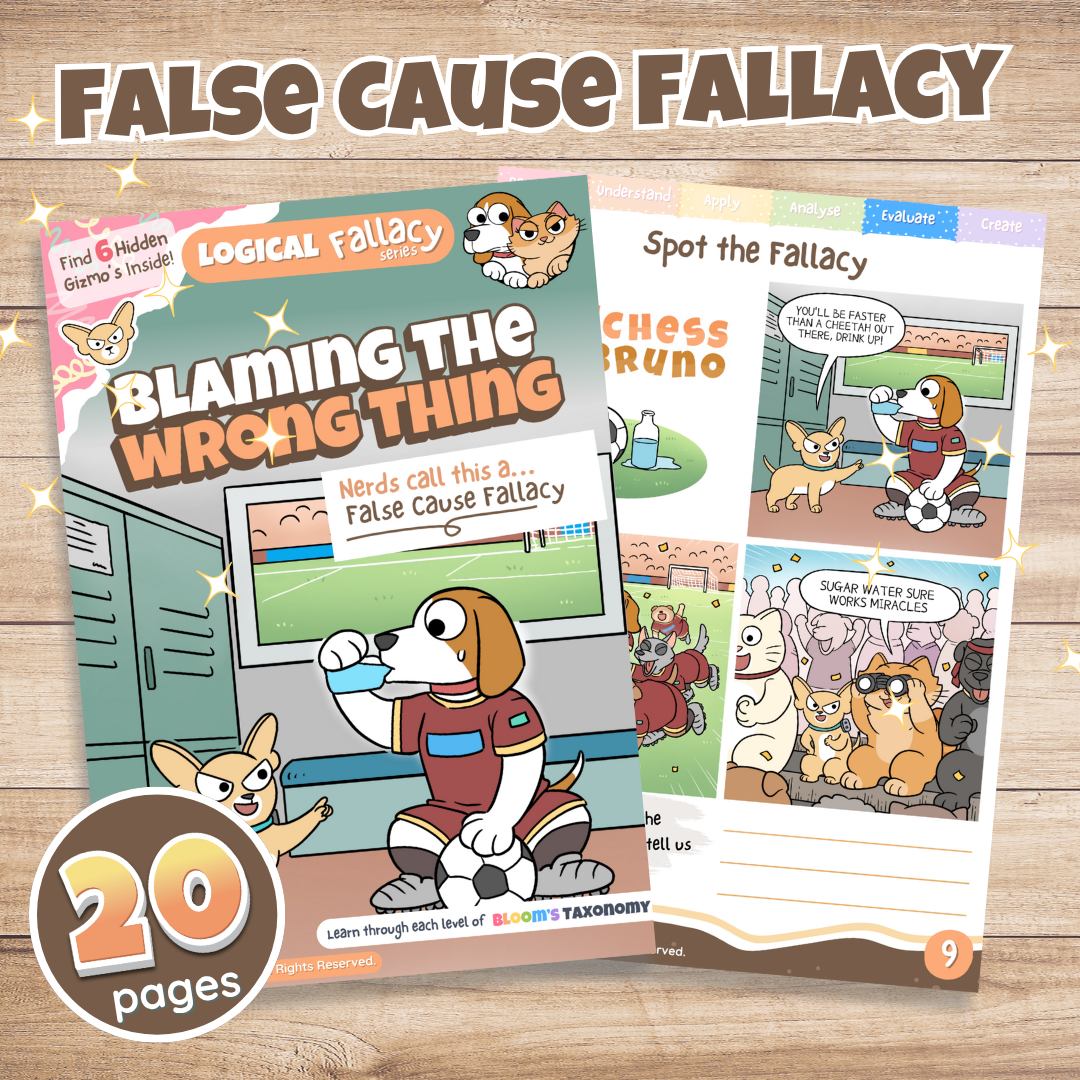
That's the False Cause fallacy - assuming one thing caused another just because it came first. This 20-page pack teaches your kids to catch it, through one true story from history, an original comic, and hands-on activities.
⭐⭐⭐⭐⭐ Rated 5.0 on Etsy & TPT · Written by a real history teacher, drawn by hand, no AI.
The story inside
Most fallacy resources are a definition on a slide and a matching worksheet. This one teaches through storytelling - your kids watch the False Cause run medicine for two thousand years and kill a president, laugh at it in a comic, then hunt for it in the wild. That sequence is why it sticks. Every word is researched from the original history books and written by hand - no AI, every fact checked.
This pack tells the story of bloodletting - one of the longest-running false causes in human history. Got a fever? Too much bad blood. The fix? Slice you open and drain you. If the patient recovered, the doctor declared "the treatment worked!" Spoiler: it didn't. The body usually healed itself despite the blood loss, not because of it.
For 2,000 years this fallacy ruled medicine. Hippocrates wrote that removing blood restored balance, and everyone trusted the old ideas without question. During a yellow fever outbreak in 1793, doctors bled thousands on the same faulty logic. Then the most famous victim: in 1799, when America's first president George Washington had a throat infection, his doctors drained half his blood. The infection didn't kill him - the cure did.
It wasn't until Dr Pierre Louis brought actual data in the 1800s - comparing patients who were bled with those who weren't - that people realised bloodletting harmed far more people than it helped. The pack closes with a line your kids won't forget: "Next time you knock on wood, remember it probably doesn't influence anything - and be thankful nobody's trying to cure your cold by stabbing your arm."
What's in the pack
Illustrated historical story - bloodletting, George Washington's death, and how the false cause fallacy ruled medicine for 2,000 years.
Original comic - Duchess and Bruno hit the False Cause in a scenario your kids will recognise instantly, with a "Break It Down" page that connects the joke to the concept.
Real-life examples - spot the fallacy in advertising, social media, news and politics.
False Cause breakdown - clear definition, worked examples, and activities that build to mastery.
Interactive activities - Code Breaker puzzle, Match the Fallacy, The Great Word Hunt, and a Draw Your Own Comic page.
Hidden Gizmo hunt - a sneaky character hidden somewhere in the pack.
Answer sheet - for teachers, parents and group leaders. No prep required.
Bonus - the Expansion Pack (new) - a printable deep-dive question booklet that takes the False Cause from "I get it" to "I can pull it apart," with questions that get your kids testing the logic, arguing both sides, and hunting the fallacy down in their own thinking. Included free with your digital download, in both A4 and US Letter.
You'll receive a professionally printed 20-page A4 booklet on quality stock, colour and black-and-white pages, answer sheet included, posted from the Gold Coast - plus the full digital file delivered instantly to print again any time. Prefer digital only? The complete pack downloads instantly, no shipping, no wait.
Who it's for & curriculum
Teachers wanting a critical thinking activity that actually engages middle schoolers, not just occupies them.
Homeschooling families who want structured, curriculum-aligned content that doesn't feel like a chore.
Parents who'd rather their kids interrogate a claim than swallow it.
Debate coaches and gifted programs looking for supplementary material with real depth.
Designed for ages 10+. Used successfully in middle school, high school, homeschool and family settings - and plenty of adults have quietly worked through it themselves.
Curriculum alignment. Aligned to critical thinking and literacy standards across three national curricula. Australia (Australian Curriculum): Critical and Creative Thinking; English; Visual Arts. United Kingdom (National Curriculum): English; Art & Design; Citizenship. United States (Common Core): ELA - analysing texts and evaluating arguments; Standards for Mathematical Practice. Suitable for Grade 6 and above.
Guarantee & FAQ
The First Pack Promise. Read it with your kid. If they don't ask for the next one, email us within 30 days and post the booklet back - we'll refund you in full. No restocking fee, no store credit, no interrogation about why. (Applies to printed packs. For digital, grab the free Bandwagon pack first so you know exactly what you're getting.)
Need help? Anything arrives damaged, or you've got a question - contact us and we'll sort it out.
Terms of use. Personal or single-classroom use only. Not for sharing, reselling or commercial use.
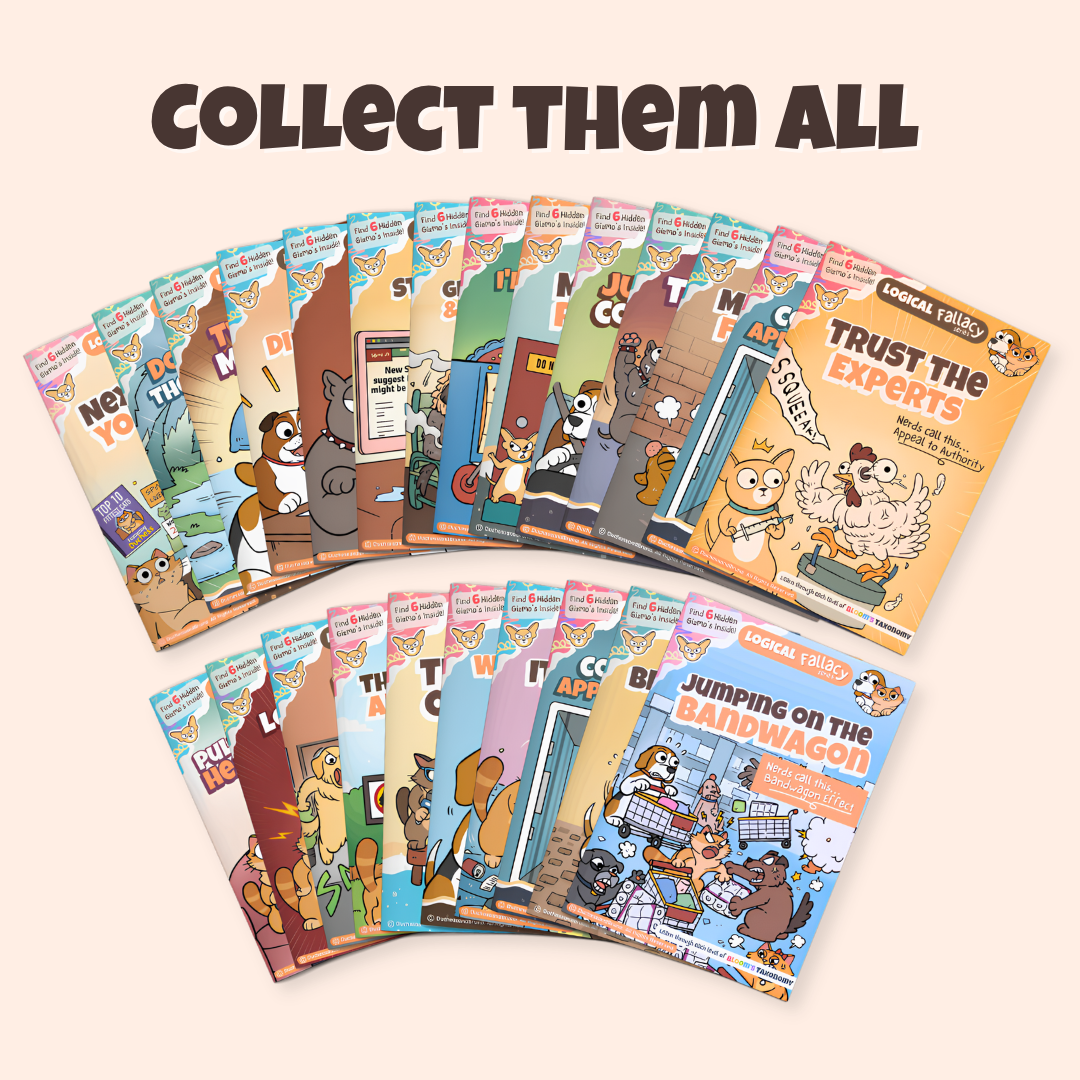
All 24 fallacies in one box - save over 45%, with free shipping.
Get the complete unitOr start smaller - start with the 6-pack Starter Set
Share